The Story Of How It All Happened
I Had No Idea What I Was Doing
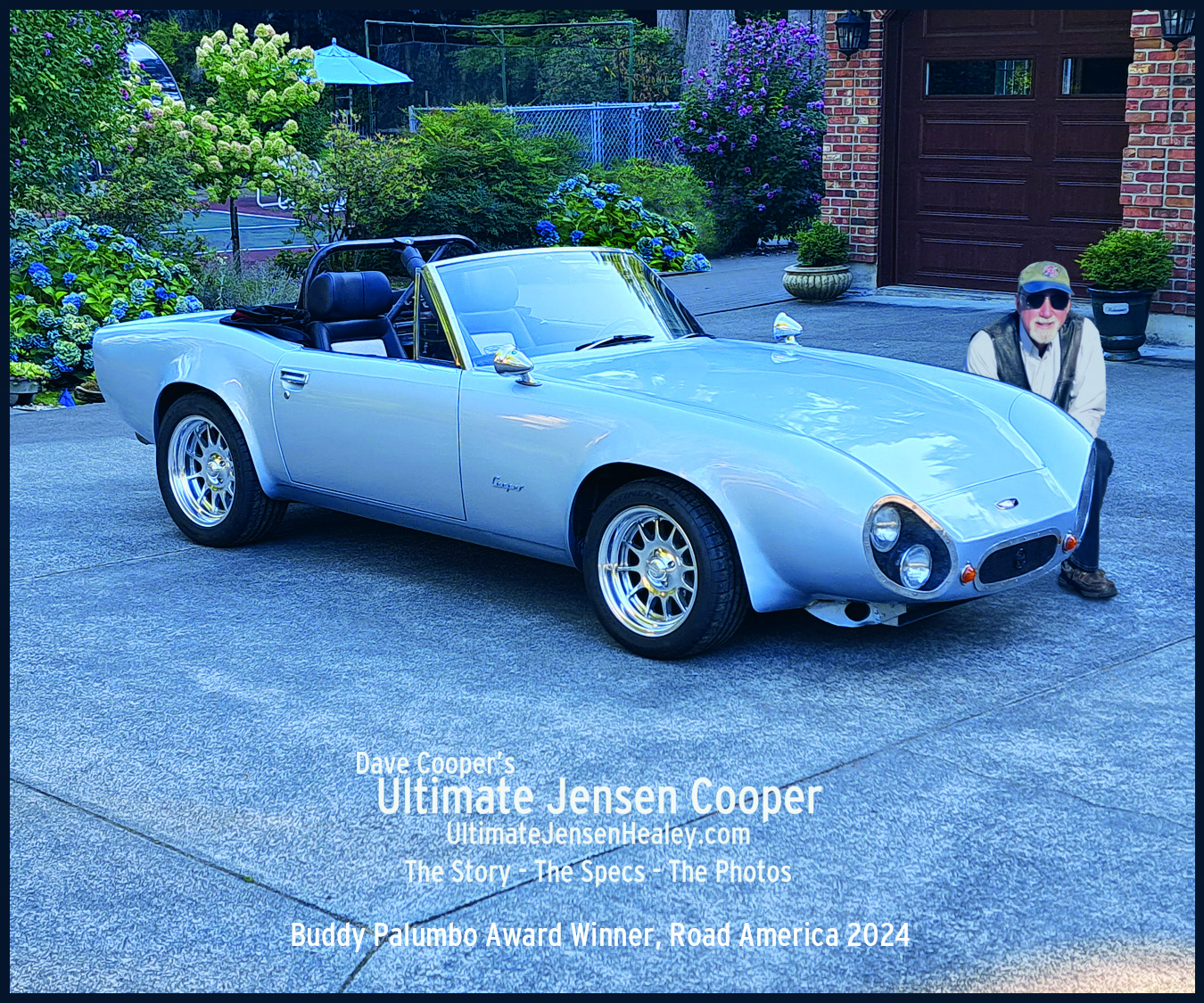
Okay, this is the convoluted story of how I was crazy enough to spend 40 years and a ridiculous amount of money to build what I thought was a real sports car. Far more time and probably more blood, sweat and tears than Jensen Motors, Kjell Qvale and Colin Chapman, the three principles behind the Jensen-Healey, ever spent on the project. They are all dead now (RIP and thanks guys) so I think that means I am free to call my car whatever I want.
As far as I am concerned it is a perfect sports car. I had to build it myself, for myself, but now I have the car that I had been looking for. I call my car a Jensen-Cooper.
So, why do I think it is such a great sports car? And why did I build it? And how did I build it? That's what this web site is all about. The “what”, the “why”, the “how”.
So what exactly is the Ultimate Jensen‑Cooper?– A successful racing car: Jensen‑Healeys have won five SCCA National Championships and finished a close second twice.
– Great handling — an SCCA Jensen‑Healey pulled 1.112 g on a skidpad using 1973 wheels and tires with very few suspension modifications. R&T SCCA Road Test here.
– My car is better and faster than the SCCA J‑H because I didn’t have to follow any rules. So I didn’t. I started with a burned‑out wreck that was paid for and had the opportunity to build it from scratch — as fast and as beautiful as I wanted — and it includes almost all of the race‑winning SCCA J‑H chassis modifications.
– Finally, it is a convertible sports car (an imperative) that drives and looks like it belongs with the classic sports cars of the 60s… in my humble opinion. Hopefully after you read this, you’ll agree with me.
So how fast is a Jensen‑Cooper? (Jump to 'Engine Section')
SCCA Jensen‑Healey vs Ferrari Daytona (Jump to Page 3 of 'The Story')
In the Beginning
At the time (1983) absolutely no one built the kind of sports car that I wanted. Not one builder. Not one car. They still don't. And it drove me nuts. I knew what I wanted, but I looked everywhere and I couldn't find it.
In 1984, after the engine fire, I started building the kind of sports car I wanted — but without a shop, a garage, or even a lean‑to (future garage happening in the background).
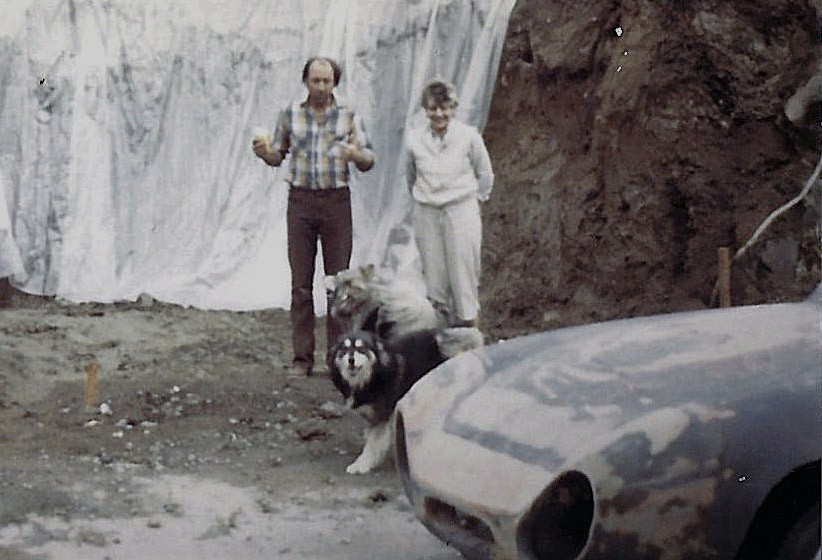
What I wanted was a car that came as close as possible to the classic definition of a real sports car — something you could drive around town Monday through Friday and then go race on Saturday and Sunday. I wanted a car like an Iso‑Bizzarrini GT Corvette Le Mans 1965 — except it had to be: 1. a convertible 2. better looking 3. better handling 4. less weight and 5. lots of fun and easy to drive, without power steering, brakes, windows, AC, radio etc.
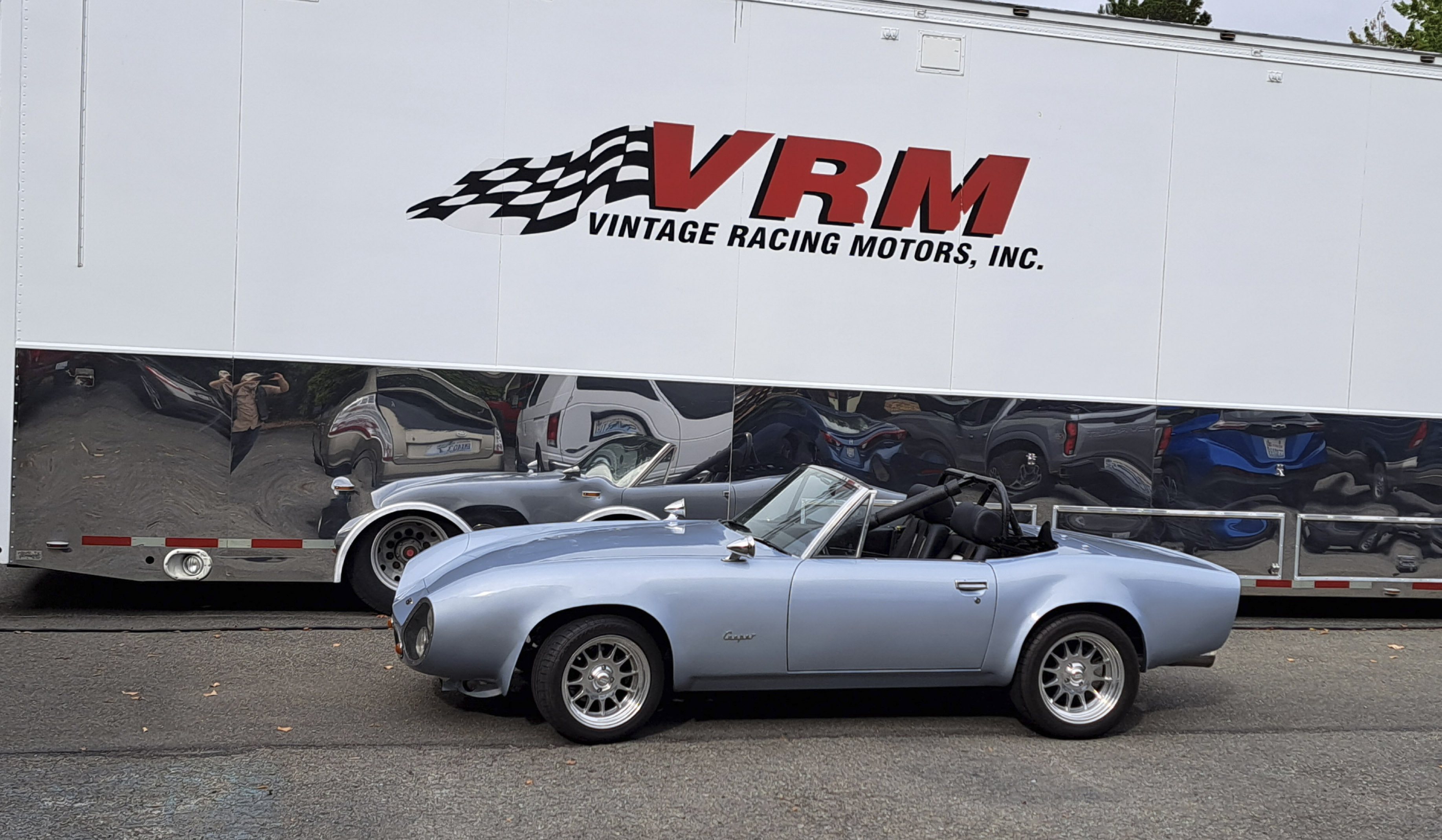
An article I wrote for the Jensen Preservation Society website over 20 years ago,
"Love Story — A Work In Progress."
Click my blue, Ultimate Jensen-Cooper, to read it…

I don't know how many of you know the back‑story of the Iso‑Bizzarrini GT, but the car's builder, Giotto Bizzarrini — the man behind the 1962 Ferrari 250 GTO — really wanted to race his own car at the Le Mans 24‑Hour Sports Car Race in 1965. Except he had no money.
So he threw some spare parts in the boot, drove the 600 miles from his home in northern Italy to Le Mans, met up with a couple of semi‑professional drivers, ran the car the entire 24 hours, finished 9th overall and first in class (the Bizzarrini beat all the Ford GT40s!!), and then Monday morning he picked up his first‑in‑class trophy, jumped in the same car that had just raced for 24 hours, and drove 600 miles back home.
Bizzarrini didn’t spend 20 million dollars to win Le Mans in 1966 like Henry Ford II did. He didn’t spend a small fraction of what Enzo Ferrari spent winning Le Mans multiple times in the 50s and early 60s. He got a little money for backing from the Rivolta family, designed and built a car, and went racing.
This is one of my all‑time favorite racing stories. There’s a great book about it — a great read. Now to me, that is a real sports car. The kind of sports car that Donald Healey — the real father of the Jensen‑Healey, who had raced cars at Le Mans — would have built at Jensen if he had just been given the opportunity.
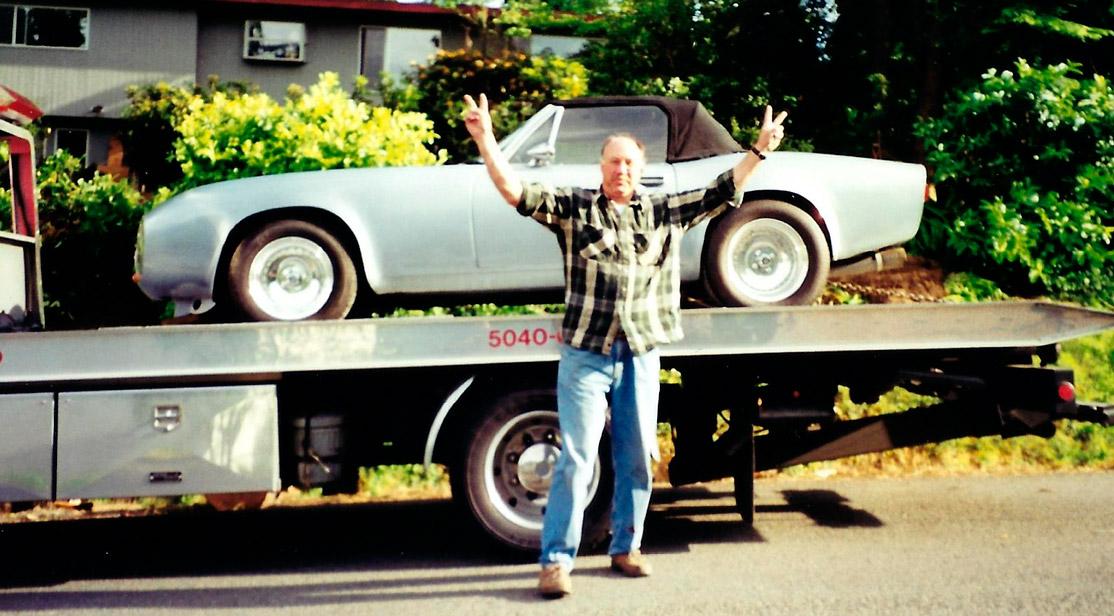
The Lucas alternator didn’t want to spin that fast…
All I had to do was build the kind of car that the Jensen‑Healey would have, could have, and should have been in the first place (in order to race at Le Mans in 1972), except that I had no idea what I was doing — I had no experience in car building at all. I decided to just go ahead and wing it; I thought I could figure it out as I went along. At least I knew what I wanted, and that was a great place to start; I just didn't know how to get from here to there.
So, the basic template for my car: a small, light, street‑legal, near flat‑out (occasional track day) vintage Le Mans‑type sports car from the late 1960s, before the government started dictating car design and performance. High performance in the late 1960s and early 1970s would be roughly:
- 0–60 in 5.5 seconds or less
- 0–100 in 14 seconds or less
- ¼ mile in 14 seconds or less
- top speed 145–150 mph
- better than 0.9 g on a skidpad
Which would make it faster than a 1964 Shelby Cobra 289 with its antiquated aerodynamics and leaf‑spring rear suspension, or...